Family is everything to me. Baseball is a close second. What better way to combine my two favorite passions than to write about them! My three children each have a different baseball team, hence the title, "Three Unassisted". I write about not only my thoughts but also the musings of Ryan (Yankees), Caitlyn (Phillies) and Matthew (Mets). I may have grown up a Yankees fan but since family is greater than ball, I also root for the Phillies and Mets. I love talking about my kids. I love talking about baseball. That lethal combination will keep you coming back for more. Happy reading!
Once upon a time, I was the editor of Venom Strikes, a blog dedicated to the Arizona Diamondbacks. It’s true. Just Google, “Tom Lynch Venom Strikes” and you can link to one of my articles like this. When I tell people that I am a huge baseball fan and that I once blogged about the Diamondbacks, inevitably they want to know how a Yankees fan in New York became a writer for the Snakes. The answer is I was asked and so I obliged. That makes me one of the only people in the tristate area that has a rooting interest in the Arizona Diamondbacks.
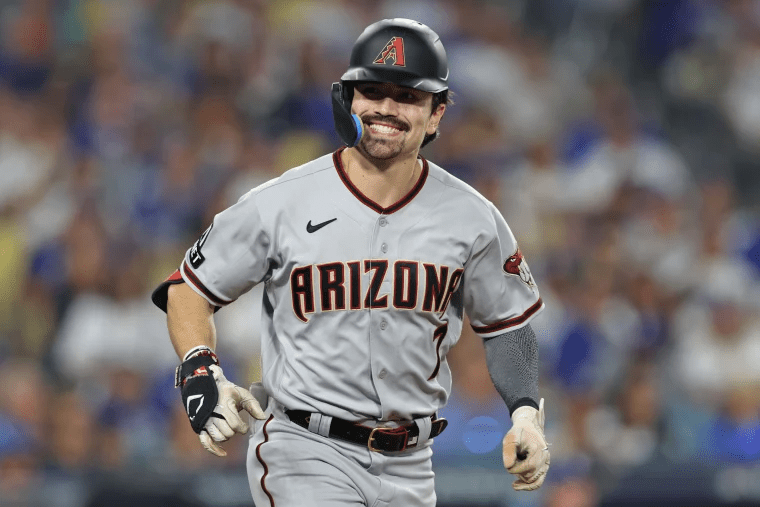
Corbin Carroll has lately been showing off his All Star form. Photo from NBC News
But that’s not what this entry is about.
The D’backs are the defending National League champions yet have had an uneven start to this season, to say the least. They sit at 20-22, too early to panic but fair to wonder if they can make the playoffs. It has been one of the those seasons where pieces have been missing or underperforming. Lourdes Gurriel Jr. started off on fire while Corbin Carroll was in a major slump. Now, Carroll has seemingly turned the corner and Gurriel is batting .235. Jordan Montgomery arrived just as Merrill Kelly got hurt. Eduardo Rodriguez hasn’t pitched yet. Paul Sewald recently returned and Kevin Ginkel has not been the playoff Kevin Ginkel. On the bright side, Joc Pederson has been a solid addition and Ketel Marte is looking like Top 5 MVP Ketel Marte.
Remember, Arizona finished the 2023 season with an 84-78 record. It won’t take much effort to reach that number this season but it may not be good enough for the playoffs in 2024. In order to reach their full potential of being a 90 win, postseason team, the yo-yoing needs to stop and the killer instinct that was on display during that October series in Philadelphia needs to return by the end of the month.
I was watching the Yankees-Astros game Tuesday night when Michael Kay and David Cone were talking about pitchers. I wasn’t hearing the exact background but I did perk up when I heard the name Dave Stieb. For those who are unaware, Stieb was one of the great pitchers of the 1980’s, totaling 176 victories over his 16 year career, mostly with the Toronto Blue Jays. Perhaps more memorable was the fact that it seemed like once per season, he would lose a no hitter in the ninth inning.
Dave Stieb was a great pitcher in the 1980’s. Photo from the Toronto Sun
Dave Stieb twirled five one hitters over the course of his career, three of them coming with two outs in the ninth inning. Finally, on September 2, 1990, “Sir David” completed the elusive no-hitter, beating the Cleveland Indians 3-0. This string of brilliant outings came as no surprise. Stieb is a seven time All Star and finished in the top ten of the Cy Young voting four times. In 1982, he was named the Sporting News Pitcher of the Year as he led the American League in shutouts with five and complete games with 19. When the Blue Jays made their first playoff appearance in 1985, Stieb led the American League with a 2.48 ERA as Toronto finished one game short of the World Series. After four appearances with the Chicago White Sox in 1993, he didn’t pitch for four years and made a comeback with the Blue Jays at age 40. After 19 appearances in 1998, Stieb called it a career; he still holds the most victories by a pitcher in Jays’ history.
Stieb was one of the best pitchers of his era. He gets overshadowed by names like Steve Carlton, Nolan Ryan and Jack Morris. However, if I had to win one game against any one of those great pitchers, I wouldn’t hesitate to give the ball to Dave Stieb.
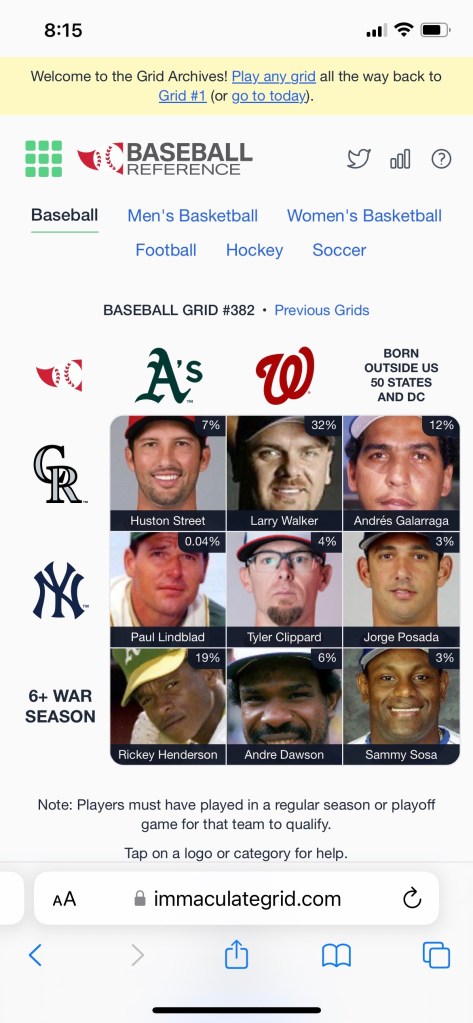
Earlier this year, I wrote about my daily activity of playing Immaculate Grid. With my oldest son coming home from college in a couple of days, our playing family will be complete. From time to time, I will be featuring players whom I consider Immaculate Grid Superstars. This can be someone who has bounced around from team to team, thereby making certain grid boxes easy. Or, it is a player whom I know will get a low percentage of respondents. Today’s post features the latter option: former pitcher Paul Lindblad.
It is amazing that I even would think of Paul Lindblad. After all, he retired after the 1978 season when I was five years old. Yet, he sticks out because back when I first started collecting baseball cards, I needed two players to complete my Topps 1979 New York Yankees: Lindblad and Gary Thomasson, two players who saw extremely limited time with the Yanks. Lindblad was the proud owner of three World Series rings, two with the Oakland A’s in 1973 and 1974 and one with the Yankees in 1978. He also pitched for the Washington Senators who later became the Texas Ranges. Three teams may not seem like a lot for Immaculate Grid but if you get stuck in a grid, Lindblad will provide a nice low score as my picture above demonstrates.
Besides the three championships, other notable career accomplishments for Paul Lindblad include a combined no hitter for the A’s on September 28, 1975. While with the Rangers in 1972, he led the American League in appearances with 66. The lefty was a valuable member of the Oakland bullpen in 1974 sporting a 2.04 ERA in over 100 innings pitched. Paul Lindblad enjoyed a successful 14 year career in the Majors and is now your first Immaculate Grid Superstar.
This has been a rough first month for Major League Baseball starting pitchers. A rash of season ending injuries to multiple starters, including All Stars Shane Bieber and Spencer Strider, has left fans, players and media alike wondering what is the culprit. I come here not with any definitive answers (though I have ideas) and instead propose acknowledging someone who doesn’t light up radar guns. He doesn’t wow you with spin rates and knee buckling curves. He’s what you call an artist and right now he is painting a masterpiece of a season.
Give it up for Ranger Suarez, please.
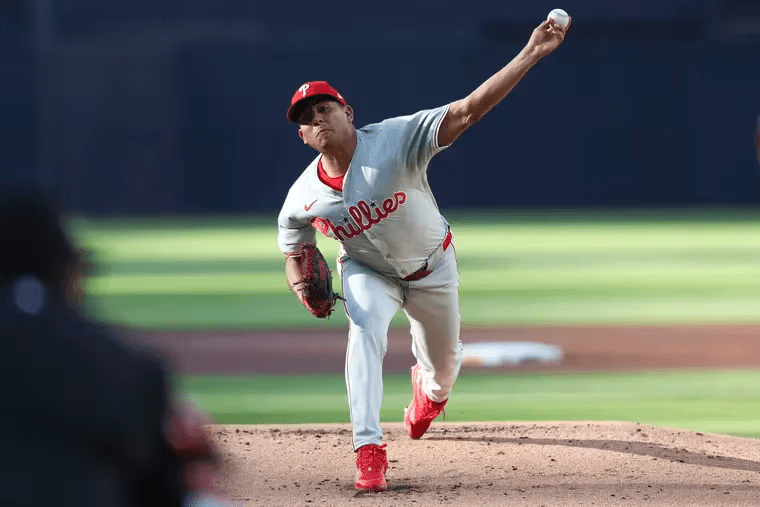
Ranger Suarez can hopefully change a lot of minds on pitching. Photo from the Philadelphia Inquirer
The 28-year old left hander is coming off a streak of 32 consecutive scoreless innings, tied for fifth best in Philadelphia Phillies’ history. To call this a breakout season so far is an understatement. His ERA is a miniscule 1.32 and he has thrown one of the Majors’ only complete game shutouts. He gives the Phillies a formidable 1-2-3 combination with Zack Wheeler and Aaron Nola. Yet, outside of Philadelphia, there doesn’t seem to be a lot of fanfare about Suarez’s work. The easy and correct answer is that he is not a strikeout pitcher. He has 40 K’s in 41 innings pitched. He doesn’t throw 98 miles an hour. He doesn’t scream after a big out.
I’d rather focus on the fact he has only issued six walks and 20 hits. That translates to a phenomenal .0634 WHIP (Walks and Hits per Innings Pitched.) All the big pitching talk revolves around strikeouts per nine innings, an obsession that is killing the pitching profession. Suarez’s success is a credit to both his physical ability and his acumen in knowing HOW to get batters out. That to me is much more impressive than someone looking to hit triple digits on the radar gun on nearly every pitch. Large amounts of strikeouts leads to shorter outings by your starting pitching and more use of the bullpen. Suarez’s pitching saves the bullpen, keeps his fielders active and goes deep into games, a combination all starting pitchers should be emulating. Would we be overlooking Greg Maddux and Tom Glavine if they were pitching today?
I have no idea if Ranger Suarez’s ERA will remain below 1.50 for the rest of the season. Chances are, the laws of baseball will catch up and he will be closer to 2.00 or higher by the end of the season. However, what I do know is that the only way for the baseball establishment to become less reliant on velocity and spin rates is for Ranger Suarez to out together a string of Cy Young worthy seasons. Maybe then we will focus on the art of pitching. I’ll be rooting for him.
It was a special day at Citi Field on April 14th. The New York Mets saluted one of the great pitchers in franchise history, Dwight Gooden. Doctor K, as he is called, had his number 16 retired forever. After well documented substance and other off the field issues, it was a great day in New York to see Gooden, seemingly in great spirits, allowing all of us to reminisce about a period in time in which he owned the Big Apple. Despite a fitting conclusion to Doc’s public baseball life, I can’t help but think he has more to offer.
Dwight Gooden needs to be a pitching coach. Phot from Sports Illustrated.
In my opinion, Dwight Gooden would make a heck of a pitching coach.
I love listening to Gooden talk about pitching. You can tell that he has a reverence for the craft. He has had some tremendous teachers beginning with his father. It is fascinating to hear Gooden talk about his dad drilling him about how to become a pitcher. Mowing down Major League hitters at age 19 takes not only great talent, but a very high acumen. Gooden’s dad had a lot to do with his success in getting to the Majors at a young age but once there, Mel Stottlemyre tutored him on the art of a professional pitcher. Stottlemyre was one of the best pitching coaches of his era, first with the Mets and then with the New York Yankees. With those two great instructors, it’s no wonder Doc enjoyed a great deal of success early in his career. Combine that with his already high pitching brain and you can see why Gooden was the perfect pitcher for five years.
I don’t know what Dwight Gooden’s future holds. I would love to see him back in uniform imparting some knowledge on today’s young pitchers. Most hurlers today are power arms and do not know how to pace themselves. Gooden would be able to teach these youngsters how to throw hard AND throw smart. For Dwight Gooden’s final act, a stint as a Major League pitching coach would be jolt for the game.
April 15th is the most important date in baseball history. Jackie Robinson became the first black man to play in a Major League game on that date in 1947. It is also one of the most monumental dates in American history, paving the way for the Civil Rights movement. It got me thinking as to what important things happened in baseball on April 16th. One of the items mentioned was that Bob Forsch threw a no hitter for the St. Louis Cardinals in 1978. Then, as so often happens in my brain, I had a random thought.
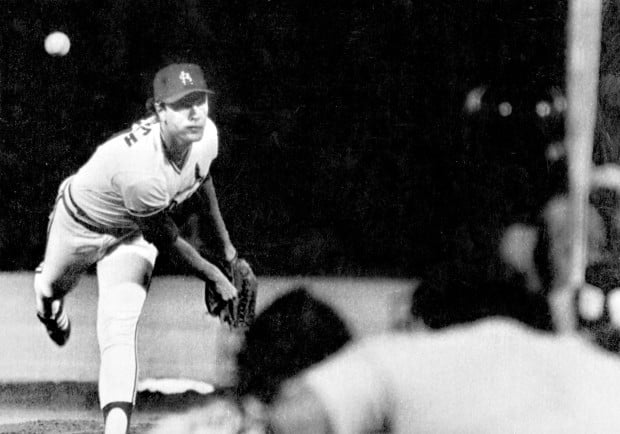
Bob Forsch, author of two no hitters. Photo from St. Lous Post-Dispatch
Self: Aren’t Bob and Ken Forsch the only brothers to throw a no hitter?
Self: Yes they are.
Ken Forsch threw his no hitter for the Houston Astros on April 7, 1979. This was the earliest date for a no hitter in baseball history. Bob Feller threw a no hitter on Opening Day but the date for that was, ironically, April 16, 1940. Though the Brothers Forsch may not have had the careers of ,say the Dean Brothers, they were solid pitchers outside of their no hitters. Bob pitched in three World Series with the Cardinals, becoming a champion on the 1982 squad. He won 168 games over his 16 year career with the Cardinals and Astros, including 20 during the 1977 season. He threw a second no hitter for the Cardinals on September 26, 1983. Back when pitchers actually hit in the National League, Bob won two Silver Slugger awards, in 1980 and 1987. Ken was an All Star in 1976 in Houston and 1981 with the California Angels. He won 114 games over 16 seasons as both a starter and a reliever. In his All Star season in Houston, he had 19 saves and with the Angels, he led the American League in shutouts with four in the strike shortened 1981 campaign.
The Forsch Brothers combined 282 victories ranks eighth on the list of brother pitching duos. While that’s miles from Phil and Joe Niekro’s”s 539 wins, their total is higher than the aforementioned Deans as well as Livan and Orlando Hernandez. Let’s give Bob and Ken Forsch their due as quality pitchers and to me for another random thought turned into an effective blog post.
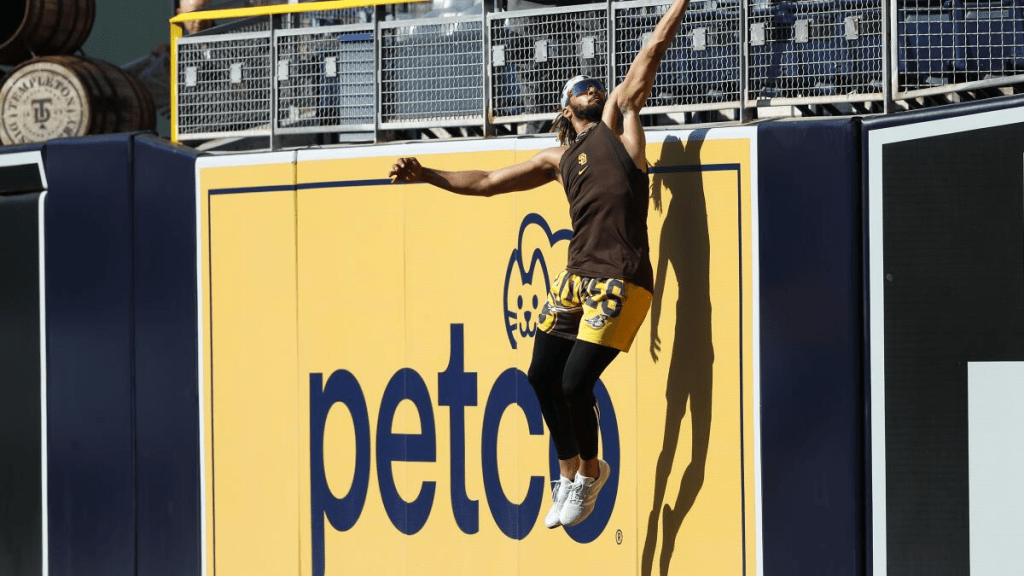
When Fernando Tatis, Jr burst onto the Major League scene in 2019, he was looked at as the game’s next great shortstop. 22 home runs at age 20 and playing highlight reel defense will put saddle you with enormous expectations. However, some quirky factors have placed the now 25-year old Tatis in right field. The largest of of these factors was Tatis missing the entire 20222 season because of a combination of a PED suspension and a shoulder injury. When 2023 began, the San Diego Padres committed Ha-seong Kim to shortstop, newly acquired Xander Bogaerts went to second base with Tatis moving to right field.
Fernando Tatis, Jr. belongs in right field. Photo from the San Diego Union Tribune
Tatis in right field has a chance to be really special.
He needs to stay there.
Once upon a time, and maybe the thought is still there today, shortstop was looked at as THE glamour position in Major League Baseball. Shortstops (and center fielders) were considered the best defensive players on the diamond and once Robin Yount and Cal Ripken, Jr. arrived, it grew into an offensive position as well. In the mid to late 1990’s, Derek Jeter, Alex Rodriguez and Nomar Garciaparra took shortstop to another level. Those three combined great offense and stellar defense at one time, akin to Mickey Mantle, Willie Mays and Duke Snider playing center field during an earlier era. Shortstop does indeed possess a number of legendary players that have called the area home.
In my humble opinion, the real glamour position is right field. I’ll give you three reasons: Hank Aaron, Roberto Clemente and Reggie Jackson. These players are among the greatest in baseball history and combined the best of what is needed as a corner outfielder: power, speed and perhaps most of a all, a cannon of an arm. They also had a certain flair for the dramatic whether it was Aaron becoming the Home Run King, Clemente putting on a show in the 1971 World Series or Jackson becoming Mr. October. I am not comparing to Tatis to the three Hall of Famers. However, he does have the same attributes of these legends, namely the ability to hit the ball a long way and cut down runners with that laser of a right arm. His giant contract will keep him with the Padres for the next decade. Can San Diego build a team around him that will allow him to reach Hall of Fame status?
The Padres did the right thing in moving Tatis to right field. He has the ability to continue the long line of superstars in the corner whom you have to keep an eye on every time he is on the field.
I have the MLB Audio App and while listening to some out of market games, many of the commercials are repeated. One of them is a clip for either MLB Network or the MLB app. They play some highlights from the previous season and one of them is when Ronald Acuna stole his 70th base to become the only member of the 40/70 club. It made think about the good old days in Major League Baseball when reaching the 20-20 club was pretty special. Oh, I’m not talking about 20 home runs and 20 stolen bases in the same season. No way. I’m talking about something that is about as rare as snow in June:
That would be a pitcher winning and losing 20 games in a single season.
Wilbur Wood, a founding member of the 20-20 club. Photo from South Side Sox
How exclusive is this membership? Since 1916, it has been accomplished only twice. Fortunately, they both happened during the first six years of my existence. It also speaks to how well my memory can work at times, much to the frustration of those important people in my life who mock me for my sometimes forgetful nature. It also speaks to my absolute love for baseball cards as when I was growing up, I would stare at the stats on the back of those pieces of cardboard for hours on end. Without further adieu, meet the powerhouse duo that is responsible for this post.
Wilbur Wood (1973) Outside of his near exclusive membership of the 20-20 club, Wood was also a left-handed knuckleballer. The only other pitcher I can think of that was a lefty knuckler was Danny Boone, who pitched for the San Diego Padres in the early 1980’s. This combination of rarefied facts may get Wood his own post in this blog. He had a run of four straight 20 win seasons in the early 70’s, finishing second in the Cy Young race in 1972. Wood started an astounding 48 games in 1973, surrendering an unsightly 381 hits. His record was 24-20 with a 3.46 ERA and he finished fifth in the Cy Young race. He would pitch for a total of 17 years, accumulating 164 victories on the mound with two top ten finishes in MVP balloting.
Phil Niekro (1979) The Hall of Famer won 318 games over a remarkable 24 year career. At at the age of 40 in 1979, Niekro went 21-20 with a 3.39 ERA in 44 starts. He finished sixth in the Cy Young voting and captured the second of his four Gold Gloves. “Knucksie” tossed a career-best 342 innings and completed 23 of his starts. I was fortunate to watch Niekro’s 300th career victory on the final day of the 1985 season, a year in which he won 16 games at age 46. At that time, I was fascinated with the fact that he was once a teammate of the legendary Hank Aaron. Niekro led the National League with a 1.87 ERA in 1967, an astounding feat not associated with knuckleball pitchers.
Last week, the Oakland A’s announced that this will be their final season in the Bay Area. The team will play for three years in Sacramento (in a Minor League park, no less) until their new stadium is ready in Las Vegas starting with the 2028 season. Thus ends an era in Major League Baseball equally defined in excellence and incompetence. The result of the move out of Oakland and into Las Vegas represents an enormous failure, and perhaps even bigger, an utter contempt for a fanbase.
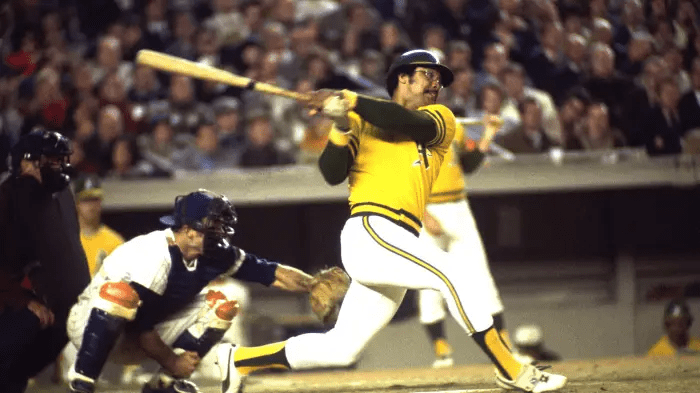
The great Reggie Jackson in Oakland. Photo from andscape.com
Let’s get one undeniable truth out of the way. If it was New York or Boston or Los Angeles or St. Louis, there is no way this happens. Those cities are considered baseball royalty with legacies of winning and rabid fan bases. Major League Baseball would not abandon those areas at any cost. They would have insisted that ownership work out a deal with their respective municipalities to keep those franchises where they belong. Oakland? It’s a more of a working class area whose perception (wrongly) is that of the “second” team in the Bay Area. It doesn’t have the celebrity following that the Yankees and the Dodgers and the Red Sox possess. And we know how important celebrities are to the folks that occupy the Commissioner’s Office. Going to Las Vegas raises the “cool” factor of baseball, with the A’s going from the “dreary” Oakland Coliseum to the bright lights of the Strip.
You know what the A’s DO have a history of: winning.
Since the franchise relocated from Kansas City to Oakland in 1968, the A’s have a nearly unmatched record in capturing World Series championships. Their four titles are only exceeded by the Yankees and equal to the amount of the Red Sox. No other club has more than three. Speaking of three, the Oakland A’s are the only team not named the Yankees to have captured three consecutive World Series titles in the over 100 year existence of the Fall Classic. They have appeared in a total of six World Series since the move to Oakland. In 1972, when playing the famed Big Red Machine from Cincinnati, the A’s won the championship without their best player, Reggie Jackson. Think about that. Oakland won a title against a legendary team without their Hall of Famer for any of the seven games. Find another instance of a franchise becoming a champion without their best player.
As for those players? MLB Network thought enough of the greatness of the teams from the 1970’s to make a documentary, but they also produced specials on three players with significant Oakland connections: Jackson, Rickey Henderson and Dennis Eckersley. Jackson was one of the great sluggers of all time, Henderson was the most dynamic player of his generation and Eckersley was virtually unhittable as a closer. Other Hall of Famers that called Oakland home include Rollie Fingers and Jim “Catfish” Hunter. Though not in Cooperstown, Dave Stewart accomplished something that may not happen again: winning at least 20 games in four consecutive seasons. From Joe Rudi and Vida Blue to Tim Hudson, Barry Zito and Mark Mulder to Matt Olson and Marcus Semien, the A’s have enjoyed rosters full of superstars that somehow go almost unnoticed by much of the baseball media. If this franchise stayed in Philadelphia all those years ago or moved to Los Angeles before the Dodgers, they would be recognized as baseball royalty.
How about this? The name “Athletics” or “A’s” needs to stay in Oakland. Current ownership does not deserve to take any bit of this all time franchise east to Las Vegas. Let him make his own history somewhere else. The A’s belong in Oakland and maybe, just maybe, the next commissioner will recognize that it is a tremendous baseball town with a rich history.
Pat Zachry died on April 4, another passing of my childhood memories with last month’s departures of Ed Ott and U.L. Washington. Zachry was a member of the New York Mets when I first started watching baseball so I got the opportunity to watch him pitch though I must confess I don’t remember many of his starts. Unfortunately, injuries derailed a career in which he won the 1976 National League Rookie of the Year and a World Series title with the Cincinnati Reds. However, the headlines (at least in New York) announcing the passing of Zachry will have the same message.
Pat Zachry was an All Star in 1978. Photo from my collection
In 1977, Zachry was part of the most controversial trade in Mets’ history. He was one of the four players traded from Cincinnati to New York which saw franchise icon Tom Seaver going west to the Queen City. It’s a trade that stings Mets fans to this day as Seaver is still arguably the greatest player in the club’s history. It’s unfair to Zachry and the other players in the deal to be known for just being “those guys” who did not have Hall of Fame careers like Tom Seaver. Let’s face it, the teams trading the superstar almost never get an equal value on the exchange. That’s just how it is. From Babe Ruth being traded to the New York Yankees to Paul Goldschmidt being dealt to the St. Louis Cardinals, the returns are not equal.
Pat Zachry was an All-Star in 1978. He pitched reasonably well during one of the worst periods in Mets history. Injuries prevented him from reaching his full potential. Doug Flynn won a Gold Glove in 1980. Steve Henderson finished as the runner up for Rookie of the Year in 1977 and batted .287 during his time in New York. The return on Seaver was probably better than most of these superstar trades. Of course, Zachry being the pitcher coming back in the deal, had enormous shoes to fill in taking on the task of replacing “The Franchise”.
Pat Zachry left us too soon at age 71. May his family be strong during this time of great difficulty and to them, he is more than just a footnote in baseball history.





 Threeunassisted